Ever found yourself staring at a wall, desperate to touch up a scuff or patch a hole, only to realize you have no idea what paint color was used? It’s a common dilemma for homeowners, whether you’ve inherited a beautifully painted space from previous owners or simply misplaced your paint cans over time. The good news is that matching an existing paint color on your walls is absolutely possible, even without a name or formula. This comprehensive guide will walk you through four effective options to perfectly color match paint with ease, ensuring seamless touch-ups and consistent aesthetics throughout your home.
Table of Contents
This post contains some affiliate links for your convenience. Click here to read my full disclosure policy.
Every homeowner eventually faces the need for paint touch-ups. Perhaps you’ve rearranged furniture and accidentally scuffed a wall, or a spontaneous gallery wall experiment left behind a constellation of nail holes. Maybe you even have an old paint can, but years of improper sealing have left you with a dried, unusable brick of color. These everyday occurrences make paint matching an invaluable skill for maintaining your home’s appearance.
New homeowners often find themselves in a similar predicament. They might love the existing wall colors but need to address minor imperfections. However, previous occupants rarely leave behind detailed records of paint brands, specific color names, or finishes. This lack of information can turn a simple touch-up into a frustrating detective mission.
So, what do you do when you’re ready to refresh your walls but have no spare paint, no color name, and no formula? Don’t panic! While the situation might seem daunting, there are several reliable methods to accurately match paint colors already on your walls. Let’s explore these practical solutions, designed to help you achieve a flawless finish every time.
4 Proven Methods to Match Existing Wall Paint Colors
If you’re wondering how to match a paint color already on your wall without any prior records, rest assured, all hope is not lost. You have several viable options at your disposal. (Alternatively, if you’re not particularly fond of the current color and are considering a change, these tips for choosing paint colors for your home can help you find your next perfect shade).
Option 1: Remove a Physical Sample from Your Wall for Professional Color-Matching.
This method is often the most accurate way to match a specific paint color, especially if you have drywall. It involves carefully removing a small piece of your painted wall and taking it directly to a professional paint store. They possess specialized equipment, such as spectrophotometers, capable of analyzing the color pigments and sheen level of your sample to create a near-perfect match.
How to Safely Remove a Wall Sample:
- Choose an Inconspicuous Area: Look for a hidden spot, such as behind a large piece of furniture, inside a closet, or near an outlet plate. The goal is to minimize visible damage once the sample is removed.
- Prepare Your Tools: You’ll need a sharp utility knife or craft knife, a ruler, and potentially a piece of painter’s tape to mark your cut.
- Make Precise Cuts: Very gently, use your knife to cut through just the paper layer of the drywall and the paint. Aim for a square shape, roughly 2×2 inches to 4×4 inches. A larger sample gives the paint store more material to analyze, increasing accuracy. For plaster walls, this method might be more challenging and could risk larger damage, so proceed with caution or consider alternatives.
- Carefully Detach the Sample: Once the cuts are made, gently peel the paint and drywall paper away. Avoid bending or damaging the sample, as its integrity is important for accurate matching.
At the Paint Store:
Present your sample to the paint professional. They will not only match the color but also help identify the paint’s finish (e.g., flat, eggshell, satin, semi-gloss), which is crucial for a seamless touch-up. The best-case scenario is that you’ll receive a perfectly matched paint, complete with the correct sheen.
Repairing the Sample Area:
After you have your new paint, you’ll need to repair the spot where you took the sample. Use a small amount of spackle or patching compound to fill the void. Once dry, sand it smooth, apply a coat of primer, and then paint over it with your newly matched paint. This meticulous repair ensures the sample removal process leaves no lasting trace, allowing you to proceed with confidence to touch up other areas.
Option 2: Utilize an Electronic Color Matcher Device.
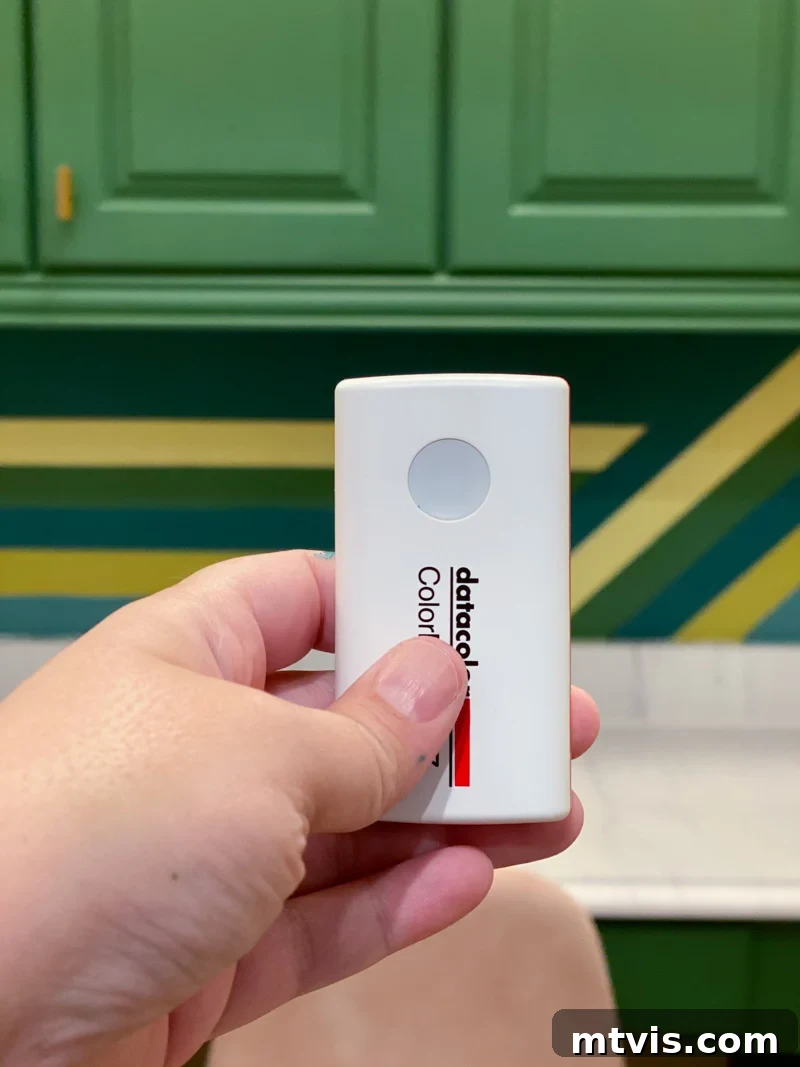
Gone are the days when sophisticated color analysis was exclusive to paint stores. Today, you can purchase compact, handheld electronic color analyzers, like the Datacolor ColorReader EZ (which I personally use and highly recommend). These innovative devices offer a convenient and remarkably accurate way to identify paint colors from the comfort of your home.
How Electronic Color Matchers Work:
These devices operate by emitting their own internal light source and blocking out all external ambient light. This controlled environment allows them to precisely measure the true color of a surface, avoiding distortions caused by varying room lighting conditions. The sensor reads the color data, which is then sent via Bluetooth to a dedicated app on your smartphone or tablet. The app processes this data and provides you with the closest paint color matches from various brands, often suggesting specific color names and numbers.
My Experience with the Datacolor ColorReader EZ:
My Datacolor EZ Color Reader is a compact and surprisingly affordable tool. I’ve found it to be exceptionally accurate for a wide range of colors. However, it’s worth noting that it can sometimes struggle with very light or pure white paint colors. For instance, when I tested it on my walls painted with Pure White by Sherwin-Williams, it didn’t include that specific color in its results. This can happen because white paints, in particular, are highly susceptible to variations in lighting, reflecting surrounding colors and making precise digital identification more challenging. (I delve deeper into how light affects paint colors in my post about how to choose paint colors).
Beyond Wall Paint:
The versatility of an electronic color matcher extends far beyond just matching wall paint. You can use it to pull colors from virtually any object or surface. Imagine finding the perfect paint shade to complement a favorite piece of artwork, a unique fabric pattern, a vibrant rug, or even a decorative cushion. This tool opens up a world of possibilities for creating cohesive and aesthetically pleasing color palettes throughout your home decor projects.
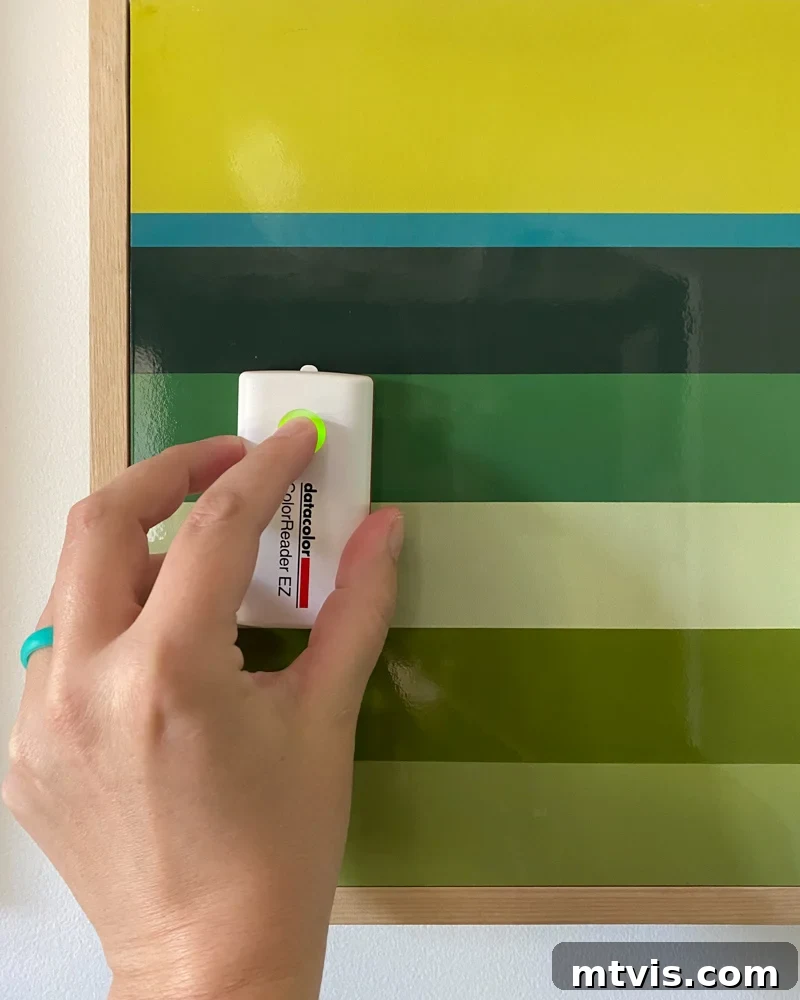
The image below provides an example of the information you receive within the accompanying app after using the Datacolor ColorReader EZ to match a color from a wall or object. It typically shows the closest matches from various brands, along with their respective color codes and sometimes even suggested coordinating colors.

Option 3: Leverage a Paint Matching Mobile App.
In our increasingly digital world, many major paint companies offer their own mobile applications designed to simplify the paint selection and matching process. Brands like Behr, Valspar, and Sherwin-Williams have developed user-friendly apps that can help you find a close paint color match directly from your smartphone.
How Paint Matching Apps Work:
While each app may have unique features, the core functionality remains consistent: you download the app, use your smartphone’s camera to capture a photo of the paint color you want to match, and upload it to the app. The app then analyzes the colors in the image and presents you with the closest matches from its brand’s extensive color library. Some apps even offer augmented reality features, allowing you to “virtually paint” your walls on screen to visualize different colors.
Critical Tip for Accuracy:
For the most accurate results when using a paint matching app, it is absolutely vital to take your photo under ideal lighting conditions. Always use natural light only. Avoid artificial lights, such as lamps or overhead fixtures, as they can cast yellow, blue, or other color tones that distort the true color in your photograph. Stand facing the light source (e.g., a window) to get the most balanced illumination. The clearer and more neutral the lighting in your photo, the better the app will be able to identify and match the color.
Pros and Cons:
Paint matching apps are incredibly convenient and free to use, making them an excellent starting point for identifying a color. However, their accuracy can be limited by the quality of your phone’s camera, ambient lighting, and the display calibration of your device. While they may not provide a perfect match every time, they can certainly narrow down your options and give you a solid lead on potential color names to explore further.
Option 4: Repaint the Entire Affected Wall from Corner to Corner.
When the first three options don’t yield the perfect match you need, or if you prefer a guaranteed seamless finish, repainting the entire affected wall is your most reliable solution. While it sounds like more work than a simple touch-up, this method cleverly circumvents any slight discrepancies between your new paint and the old.
The “Corner-to-Corner” Advantage:
The key to this strategy is painting the wall from one corner to the other. You do not necessarily need to repaint the entire room. The reason this works so effectively is rooted in visual perception. When two slightly different shades meet in an interior corner, the subtle change in light and shadow at that intersection makes the color difference virtually undetectable to the human eye. Your brain perceives the different planes of the walls as separate surfaces, naturally accommodating minor variations.
When to Choose This Option:
- You’ve tried other matching methods, but the color difference is still too noticeable.
- The original paint has faded significantly due to sunlight exposure, making an exact match impossible.
- The area needing touch-up is large or centrally located, making any mismatched spot highly visible.
- You want a consistently fresh look for that specific wall.
A Real-Life Example:
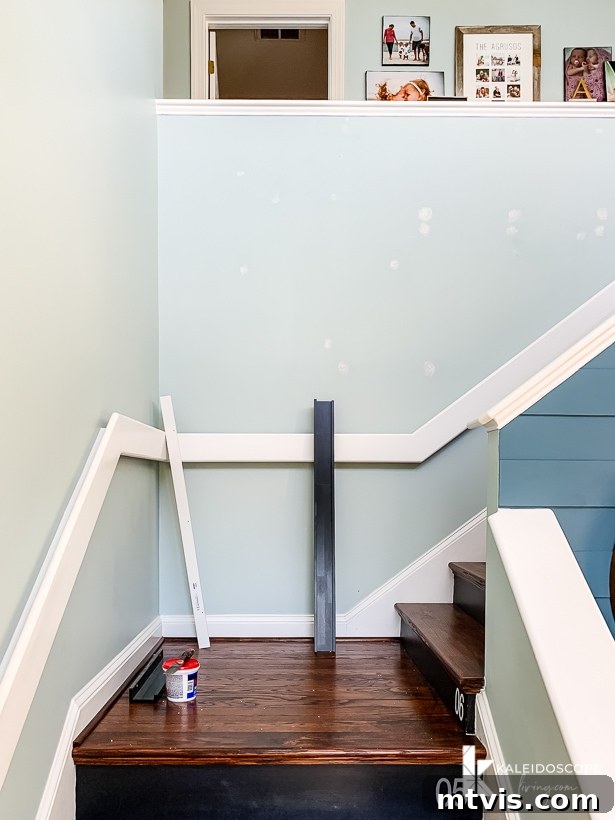
We encountered this exact situation in our old house. After moving into our current home, our two-story foyer needed painting, and we lacked a ladder tall enough for the job. We hired a painter and specified a particular paint color. Later, we discovered he had color-matched it using a different brand and, unfortunately, left us with no leftover paint. When we attempted to color-match it ourselves for touch-ups, we faced repeated failures across multiple brands; a perfect match simply eluded us.
Consequently, when we later installed new artwork on our staircase, requiring us to patch holes from a previous gallery wall, we couldn’t just touch up the patched spots. The mismatch was too obvious. Our solution? I painted the entire staircase wall, extending from one end to the corner where it met another two-story wall. The slight difference at the corner was completely unnoticeable, and I was incredibly relieved that we didn’t have to repaint the entire vast foyer!
There you have it—four distinct and effective strategies for matching paint colors already on your walls, even when you have no spare paint or documentation. From careful sample removal to leveraging modern technology or opting for a strategic repaint, these options empower you to tackle any touch-up project with confidence and achieve professional-looking results.
Essential Tips for Long-Term Paint Color Management
While the methods above are excellent solutions for existing paint dilemmas, the very best option is to prevent the problem from recurring. Make it a habit to record your paint colors and finishes whenever you undertake a painting project. This simple step can save you immense time and frustration down the road.
Create a Paint-Color Record Keeper:
I personally use my copy of Designer in a Binder to meticulously document all the paint colors, finishes, and even the rooms they were used in for our current house. This central record keeps everything organized and easily accessible.
For those who don’t have Designer in a Binder, I’ve created a dedicated Paint-Color Record Keeper, available exclusively to my subscribers. It’s a simple, printable tool that takes mere seconds to fill out after a paint project. This small effort will eliminate future headaches and, should you ever decide to move, your home buyers will undoubtedly appreciate such thorough records!
Ensuring you always have access to your paint information is a smart homeowner habit that pays dividends in convenience and peace of mind.
More Helpful Paint and DIY Resources
SEE ALL PAINT POSTS
-
9 Life-Changing Painting Hacks Everyone Should Know
-
How Durable are DIY Painted Kitchen Cabinets?
-
How to Paint Kitchen Cabinets (From a DIYer Who Has Done it 3 Times)
-
How Have Our Painted Countertops Held Up?
-
How to Paint IKEA Furniture and Mistakes to Avoid
-
How Much Paint Do I Need for My Room?
Other posts you may find helpful:
- How to Choose Paint Colors for Your Home: 6 Simple Tips to Follow
- Samplize Peel & Stick Paint Samples: An Unbiased Review
- Sherwin-Williams Alabaster Color Review With Pictures
- Beautiful Blue Paint Colors Designers Love & Use
Curious about my personal approach to transforming rooms and spaces in our home? Explore Designer in a Binder® for an affordable and simple guide to home decoration.
For exclusive content, behind-the-scenes sneak peeks, and valuable home decor insights, be sure to subscribe to my newsletter before you leave!