
If you’ve ever found yourself pondering the perfect area rug for your bedroom, especially when it comes to sizing and placement under your bed, you’re in exactly the right place. The process of selecting a bedroom rug can often feel daunting, with questions like “What size rug for a queen bed?” or “What size rug for a king bed?” swirling in your mind. This comprehensive guide aims to demystify bedroom rug choices, providing clear answers and practical advice to help you transform your sleeping space. We’ll cover everything from the aesthetic and functional benefits of a bedroom rug to precise sizing recommendations for various bed types, and even offer tips on where to find beautiful, affordable options to complete your dream bedroom.

Table of Contents
Area rugs play an indispensable role in interior design, a topic I frequently emphasize in Designer in a Binder. A thoughtfully selected area rug has the power to anchor a room, create cohesion, and elevate its overall aesthetic. Conversely, a rug that is too small can make a space feel disjointed and incomplete, while one that is excessively large might overwhelm it. It’s all about striking the perfect balance to ensure your room feels harmonious and inviting. Beyond their visual impact, rugs also offer practical benefits, especially in bedrooms. And if you’re concerned about cost, rest assured that there are numerous excellent sources for affordable rugs, many of which we’ll highlight later in this article.
This post contains some affiliate links for your convenience. Click here to read my full disclosure policy.
Why Your Bedroom Needs an Area Rug
The importance of an area rug in a bedroom is often underestimated, even by those who appreciate good design. I’ve had to make this case many times, even to my own husband, who initially preferred to leave our beautiful new floors uncovered. However, once a rug is in place, the transformation is undeniable.
A bedroom rug serves several crucial functions:
- Defines and Anchors the Space: In open-concept homes or larger bedrooms, an area rug clearly delineates the sleeping zone from other areas, such as a sitting nook or a vanity. It creates a visual anchor for your bed, making the room feel more structured and intentional. In our former colorful master suite, we used two rugs – one under the bed and another in the sitting area – to effectively separate these distinct functional zones.
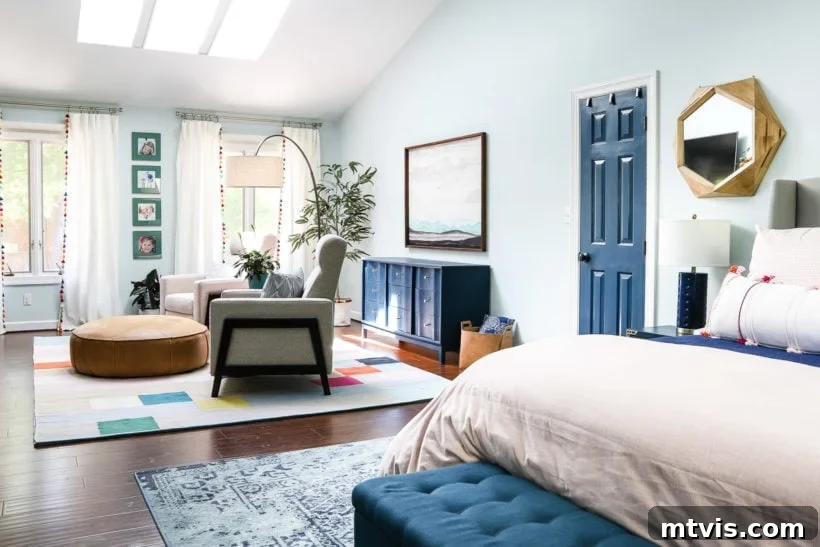
- Adds Warmth and Comfort: If your bedroom features hard flooring like wood, tile, or laminate, an area rug provides a much-needed layer of warmth. There’s nothing quite like stepping onto a soft, plush rug first thing in the morning, rather than a cold, hard floor. This enhances both the visual coziness and the literal comfort of your bedroom.
- Introduces Texture, Color, and Pattern: Beyond its practical benefits, an area rug is a powerful design tool. It’s an excellent way to infuse a bedroom with personality, adding layers of color, intriguing patterns, and varied textures. This is why we often use area rugs even in bedrooms with wall-to-wall carpeting, such as in Avery’s bedroom and Attley’s bedroom. A rug can act as a focal point, tie disparate elements together, or simply add a touch of softness to an otherwise plain carpeted floor.
Essential Bedroom Rug Considerations
- For a king-sized bed, a 9′ x 12′ rug is typically the most appropriate size.
- For a queen-sized bed, an 8′ x 10′ rug is generally the most suitable.
- Ensure your bedroom area rug extends at least 18 to 24 inches beyond the sides and the foot of your bed.
- The length of your bedroom rug should ideally run perpendicular to your bed for optimal visual flow.
- Maintain a consistent border of 10 to 24 inches between your rug and the bedroom walls.
Choosing the correct rug size for a bedroom differs significantly from selecting one for a living room, where furniture arrangement around the rug takes precedence. In a bedroom, your primary considerations revolve around the size of your bed and the overall dimensions of the room itself. You’ll also need to factor in any other substantial furniture pieces present in the space, such as dressers, benches, or nightstands. As a general rule, an 8′ x 10′ rug is commonly recommended for a queen-sized bed, while a 9′ x 12′ rug is often the best fit for a king-sized bed. We will delve into more specific sizing details for each bed type further below, so keep reading for in-depth guidance!
Regardless of your bed’s size, a good guideline is for your area rug to extend a minimum of 18 to 24 inches past both sides and the foot of the bed. This creates a comfortable landing space and ensures the rug doesn’t look too small. However, be mindful not to choose a rug so expansive that it nearly touches every wall. Aim to leave a visible margin of hard flooring between 10 to 24 inches around the perimeter of your room and the edge of the rug. This breathing room helps define the rug as an accent rather than wall-to-wall carpeting. Additionally, and this might feel counterintuitive, positioning the rug so its longest dimension runs perpendicular to your bed often creates the most aesthetically pleasing and balanced layout, visually widening the space around your sleeping area.
How to Place Furniture on Your Bedroom Rug?
The “rules” for bedroom rug placement aren’t set in stone. In fact, what works best often depends on the specific size and shape of your bedroom, as well as your personal aesthetic preferences. Instead of rigid rules, it’s more helpful to think in terms of flexible “guidelines” and “options” that can be adapted to your unique space. The goal is always to create a cohesive and comfortable look.
Three Effective Furniture Placement Options
To help you visualize the possibilities, here are three common and effective options for arranging your furniture in relation to your bedroom rug:
- Bed Only on the Rug: In this setup, only your bed frame and mattress rest on the area rug. Your nightstands typically sit off the rug, directly on the hard flooring. This option works well for maximizing the visual expanse of the rug and creating a clear zone for the bed.
- All Furniture on the Rug: This grander approach involves placing your entire bed, including the headboard, footboard, and mattress, along with your nightstands and any furniture at the foot of your bed (such as a bench or armchairs), completely on the rug. This creates a luxurious, wall-to-wall carpeting effect within the rug’s boundaries, making the room feel larger and more cohesive.
- Partial Bed & End Furniture on the Rug: This is arguably the most common and versatile placement. Here, approximately two-thirds to three-quarters of your bed (starting from the foot of the bed and extending upwards) rests on the rug. Your nightstands remain off the rug, on the hard floor, allowing them to anchor independently. Any furniture positioned at the end of your bed, like a bench or a trunk, should also sit on the rug. This method provides ample soft surface underfoot when getting out of bed while visually expanding the sleeping area.
My preferred approach to bedroom rug sizing and placement, which is also the most typical and recommended for many bedrooms, is illustrated in the sketch below. As you can observe, the rug is generously sized to extend well under approximately three-quarters of the bed. Crucially, the nightstands are positioned off the rug, directly on the hard flooring. This maintains their stability and prevents any unevenness. Additionally, this placement ensures that the rug extends at least 18 to 24 inches beyond both sides of the bed, providing a soft, warm surface for your feet the moment you step out of bed.

Choosing the Right Rug Size for Your Bedroom
Determining the “right size” rug is fundamentally dependent on the dimensions of your bed and the overall footprint of your room. The most commonly chosen bedroom rug sizes are 8′ x 10′, 9′ x 12′, and for very large spaces, 12′ x 18′. As highlighted previously, an 8′ x 10′ rug is frequently the ideal match for a queen-sized bed, while a 9′ x 12′ rug often suits a king-sized bed best. It is a critical design principle that, with only very rare exceptions, a 5′ x 8′ or 5′ x 7′ rug is simply too diminutive for a bedroom, often looking lost and out of scale, making the bed appear to float without proper grounding.
Rug Size for a King Bed
A standard king-size bed measures approximately 76 inches wide by 80 inches long. A California king-size bed is slightly narrower and longer at 72 inches wide by 84 inches long. For either of these substantial beds, an area rug should be at least 9′ x 12′. This size allows for adequate extension beyond the bed’s perimeter, ensuring comfort and proper scale. If your bedroom is particularly spacious and your budget permits, opting for an even larger rug, such as a 10′ x 14′ or 12′ x 15′, can create an even more luxurious and grounded feel, making the room feel more expansive and cohesive.
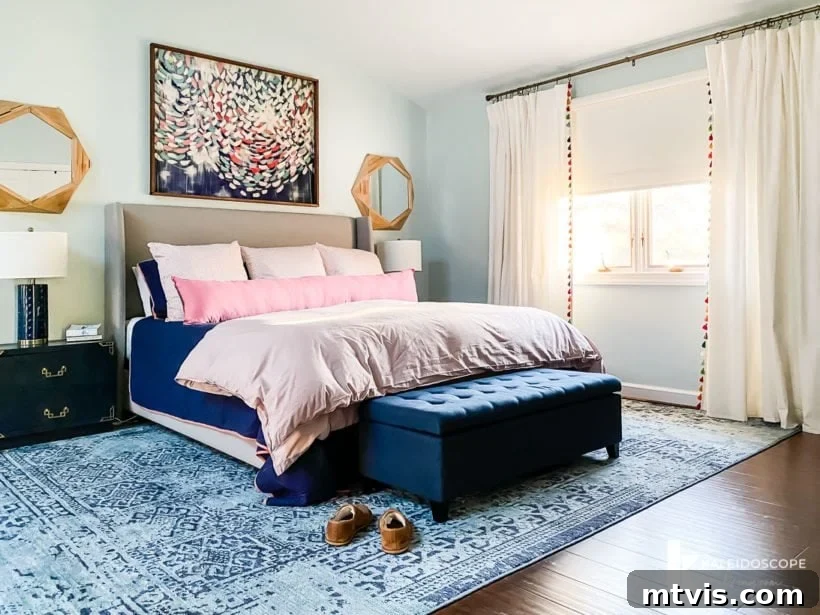
Attempting to place an 8′ x 10′ rug under a king-sized bed almost invariably results in the rug looking dwarfed and disproportionate to the bed’s imposing size. The visual balance is disrupted, and the rug fails to effectively define the sleeping area. For instance, in our current primary bedroom, we have successfully utilized a 9′ x 12′ rug under our king-size bed. This rug extends sufficiently to reach the front legs of our bedside tables, without the tables themselves resting on the rug. Furthermore, it’s large enough to accommodate about three-quarters of our bed, plus a decorative bench positioned at the foot of the bed, all while extending a comfortable 18 to 24 inches beyond the bench, providing ample soft landing space.
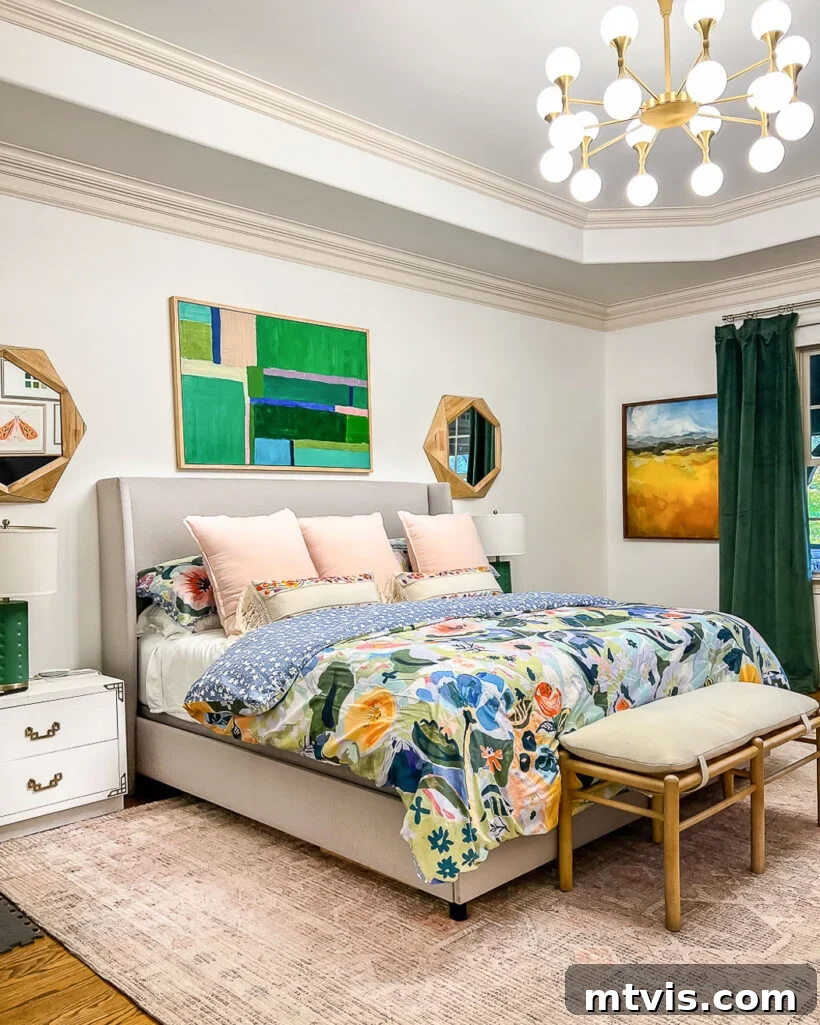
In our previous home’s colorful master bedroom, we also opted for a 9′ x 12′ rug beneath our king-size bed. However, for that specific room’s layout and aesthetic, we chose a different placement strategy: the entire bed and both nightstands were positioned to sit completely on the rug. This creates a different visual statement, enveloping the entire sleeping zone within the soft boundaries of the rug, making for a truly luxurious and encompassing feel.
Rug Size for a Queen Bed
A queen-size bed typically measures 60 inches wide by 80 inches long. For this bed size, an 8′ x 10′ rug is often the most suitable choice, providing ample coverage and creating a balanced look. As with king beds, I generally advocate for a slightly larger rug if the room’s dimensions and your budget can comfortably accommodate it. A larger rug can make a room feel more expansive and luxurious, offering a more generous soft landing area around the bed.
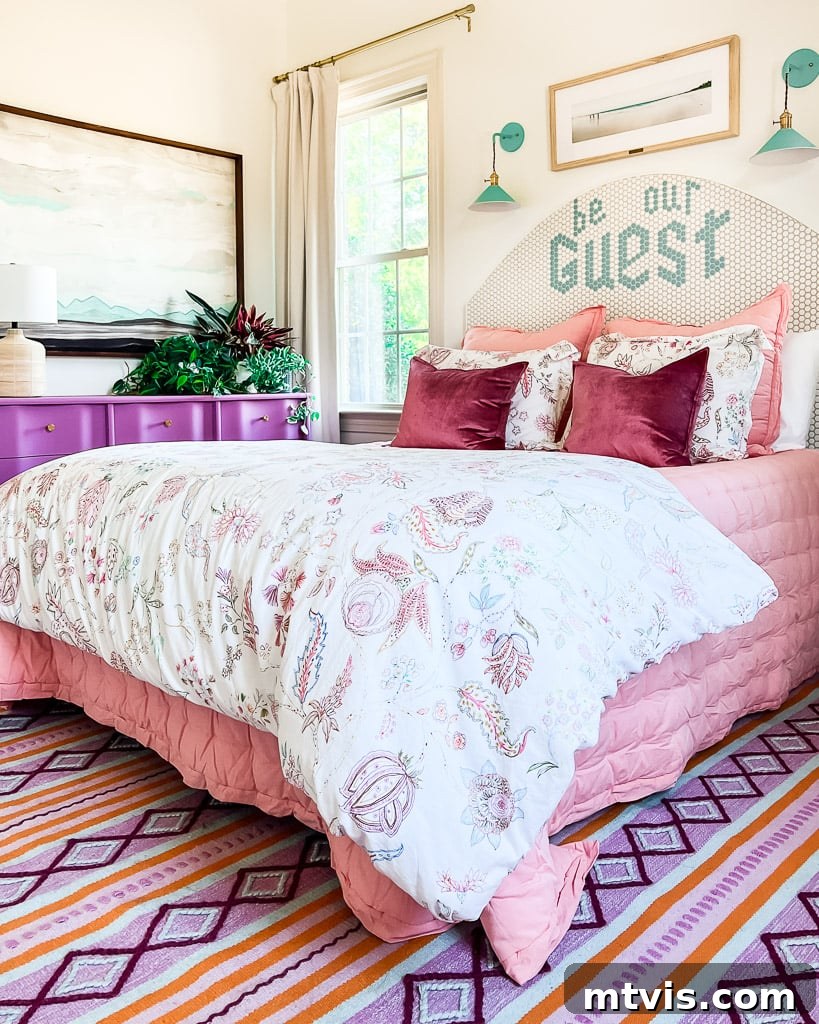
In our colorful guest room, we utilized an 8′ x 10′ rug under the queen-size bed. This choice was deliberate because the room is relatively compact, and a larger rug would have made the space feel cramped and visually overwhelming. Despite the room’s smaller size, the 8′ x 10′ rug still extends significantly beyond both sides and the foot of the bed, providing plenty of soft space underfoot and maintaining proper scale within the room.
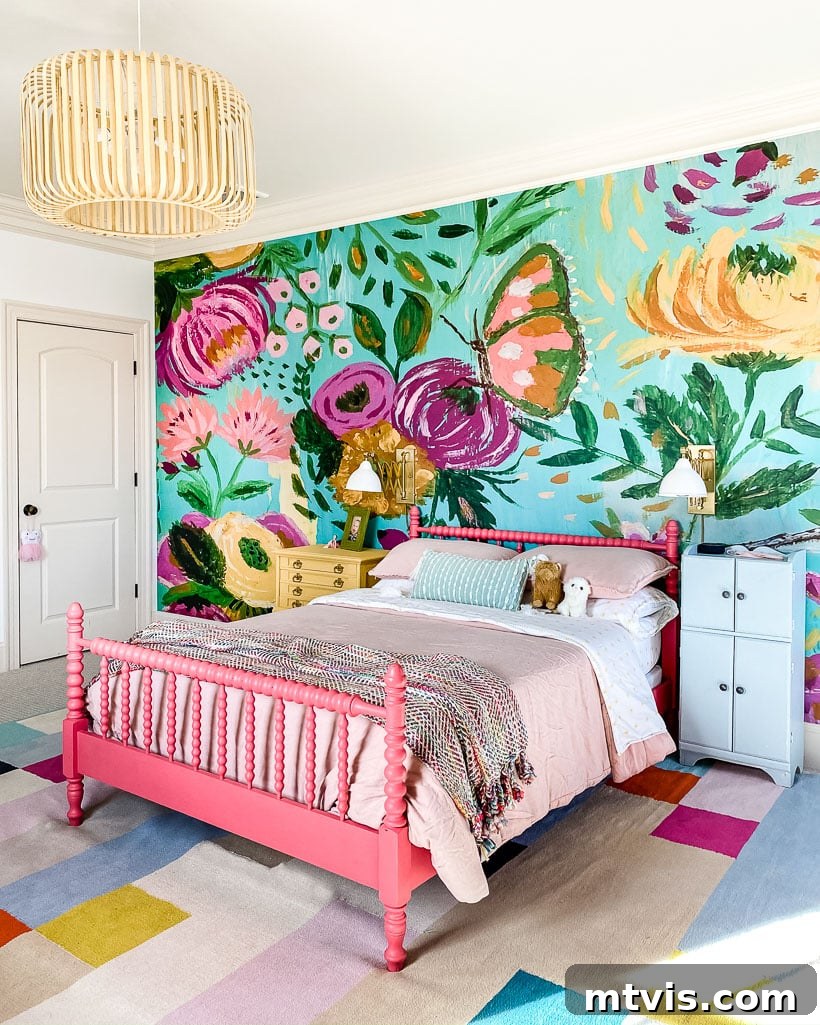
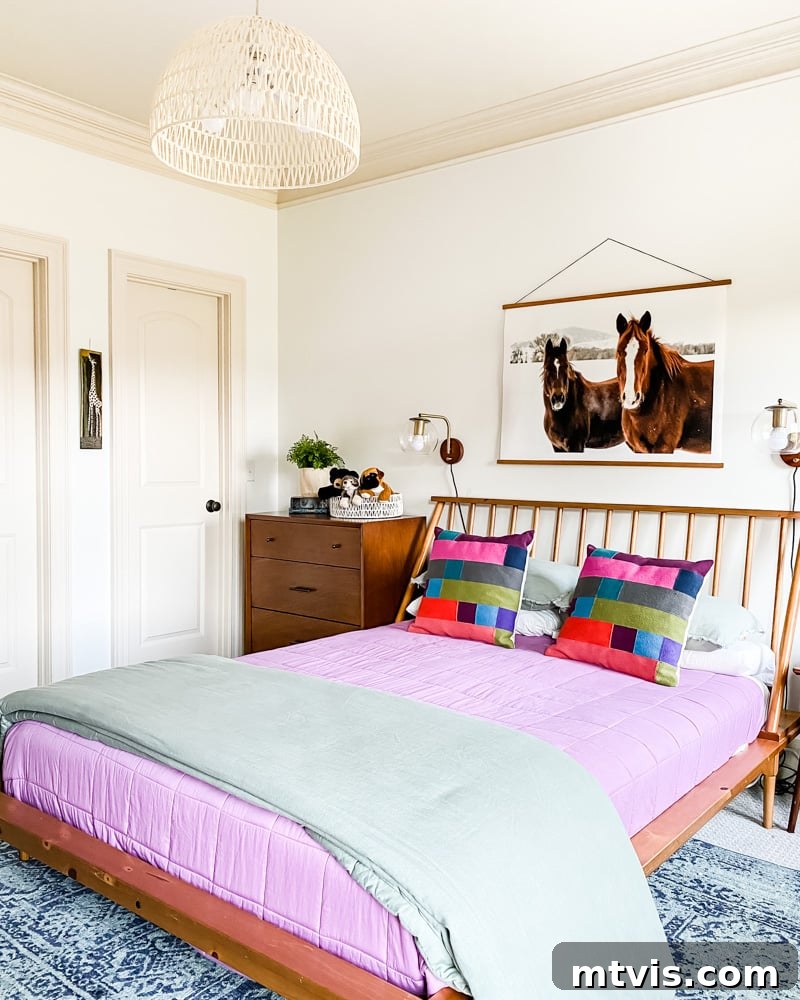
Similarly, we’ve incorporated an 8′ x 10′ area rug beneath the queen-size bed in our daughter Avery’s bedroom. It’s important to note that, yes, her area rug is placed directly on top of wall-to-wall carpeting. This demonstrates a key design principle: area rugs are so fundamental to defining and styling a bedroom that their presence should not be skipped, even if you already have existing carpet. They add layers of texture, color, and visual interest that cannot be achieved otherwise, transforming the room’s aesthetic. You can absolutely use area rugs on carpet to enhance design and comfort.
Rug Size for a Full Bed
A full-size bed measures approximately 54 inches wide by 75 inches long, making it slightly smaller than a queen-size bed. However, when it comes to selecting the appropriate area rug, my recommendation is to treat a full-size bed much like a queen-size bed. This means aiming for an 8′ x 10′ rug. While a 5’x7′ or 6’x9′ might seem tempting due to the bed’s smaller dimensions, they typically do not provide enough coverage to create the desired anchored and luxurious feel, often making the bed and rug appear disconnected.
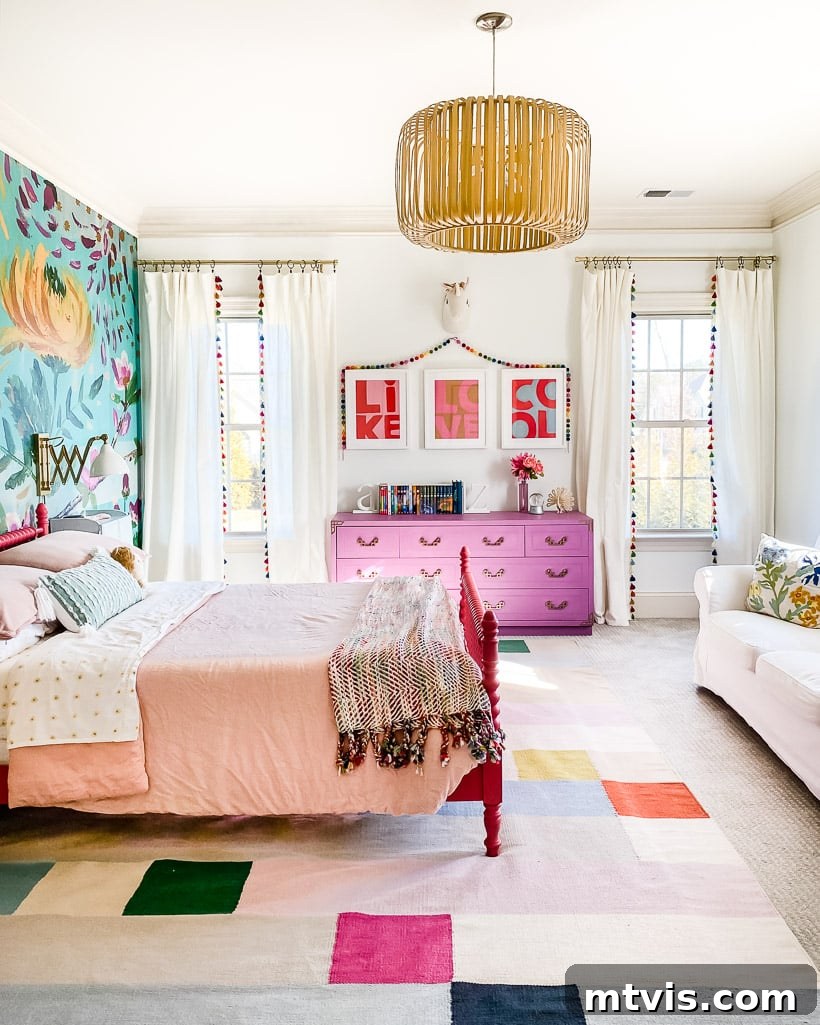
Recalling my earlier advice about opting for a larger rug if your room size and budget allow, this principle was perfectly applied in our daughter Attley’s bedroom. Even though her charming vintage Jenny Lind bed is a full-size, her room is exceptionally large. Consequently, using a more expansive rug was visually necessary to create proper scale and prevent the bed and rug from looking undersized in such a grand space. Therefore, we chose to use a 9′ x 12′ rug under her full-size bed. This significantly larger rug fills the space beautifully, grounding the bed and adding a sense of luxury that a smaller rug could not have achieved. (As a side note, this is the same rug we previously used to define the sitting area in our primary bedroom in our old home, showcasing its versatility).
Rug Size for Twin Bed(s)?
Selecting a rug for twin beds presents a few more variables, largely depending on the room’s layout and whether you have one or two twin beds in the space. A standard twin bed measures 38 inches wide by 75 inches long. If you have a single twin bed, you could likely use a 5′ x 7′ or 6′ x 9′ rug effectively. A 5’x7′ rug would allow the bed to sit mostly on it, with a comfortable amount of rug extending beyond the foot. A 6’x9′ would provide even more coverage, particularly useful if the room is a bit larger.
For a room with two twin beds placed parallel to each other, there are a couple of popular approaches. You could use a single 5′ x 7′ or 6′ x 9′ rug positioned between the two beds to create a central pathway or shared soft zone. However, in many cases, a more cohesive and visually appealing option is to use one larger rug that both beds can sit on. This might mean a 9′ x 12′ rug or even a 10′ x 14′ rug, depending on the spacing between the beds and the room’s overall size. A single large rug under both beds helps unify the space and ensures a soft surface is available when getting out of either bed, providing a more luxurious and grounded feel.
With these guidelines, I trust you now feel well-equipped to confidently choose your next bedroom rug without the stress of deciphering sizes or wrestling with placement dilemmas. Remember, the goal is always a harmonious and comfortable space tailored to your needs.
Where Can I Buy an Affordable Rug for My Bedroom?
Finding beautiful yet affordable rugs is entirely possible! I’ve curated some fantastic options for you, with prices based on an 8 x 10 size at the time of this writing. If you see a rug you love that’s currently above the listed price group, don’t despair! Rugs frequently go on sale, so keep an eye on it. You can also follow me on Like to Know It, where I often share flash sales and deals on my favorite rugs. And remember, a quality rug pad is just as important as the rug itself – be sure to check out my comprehensive rug pad guide for everything you need to know.
Affordable Rugs Under $300
Explore these stylish and budget-friendly rugs that won’t break the bank. Click on any rug below for full product details and current pricing.
(Placeholder for affordable rug collection widgets under $300. In a live environment, this would display shoppable rug options.)
Affordable Rugs Under $500
Discover more fantastic rug options in this slightly higher but still very accessible price range. Click on any rug below for full product details.
(Placeholder for affordable rug collection widgets under $500. In a live environment, this would display shoppable rug options.)
Affordable Rugs Under $600
For those with a bit more flexibility, these rugs offer even more design and quality within a reasonable budget. Click on any rug below for full product details.
(Placeholder for affordable rug collection widgets under $600. In a live environment, this would display shoppable rug options.)
More RUG Posts
SEE ALL rug POSTS
-
Designer Tips for Choosing Perfect Kitchen Rug Runners
-
How to Choose the Best Rug Size for Your Living Room
-
How to Install a Stair Runner: A Step-by-Step Tutorial
-
How to Keep Rug Corners Down – Tips and Tricks for Every Homeowner
-
The Best Places to Shop for Affordable Rugs
-
The Rug Pad Guide: What You Need to Know Before You Buy
Be sure to bookmark or save this post so you can easily refer back to these helpful tips whenever you’re ready to refresh your bedroom!
You might also enjoy these related posts for further home decor inspiration:
- How to Make a Small Room Look Bigger: 9 Simple Tricks
- Best Sofa Options for Every Color and Budget
- How to Choose Paint Colors for Your Home: 6 Simple Tips to Follow
- 8 Interior Design Mistakes You Don’t Even Know You are Making (and How to Fix Them)
- How to Make a Mood Board: A Step-by-Step Guide
Curious about my unique approach to transforming rooms and spaces in our home? Discover the strategies and insights in Designer in a Binder® – your guide to decorating with confidence and ease.
For exclusive content, behind-the-scenes sneak peeks, and fresh design inspiration delivered straight to your inbox, be sure to subscribe before you go!
(Placeholder for email subscription form. In a live environment, this would display the actual form.)